


AI disclaimer: This article was written from the livestream transcript (AI-assisted summary). Quotes and figures have not been checked against the recording audio and are pending human verification.
Event: City of Chula Vista Athletic Training Center Open House (community workshop for the Elite Athlete Training Center master plan), Wednesday, Oct. 21, 2026, 4:00 to 7:00 p.m., Chula Vista Elite Athlete Training Center, 2800 Olympic Parkway, Chula Vista, CA 91915 (time and location from the CVLD stream listing). CVLD streamed live from about 4:41 p.m. for 31 minutes.
What the workshop is for
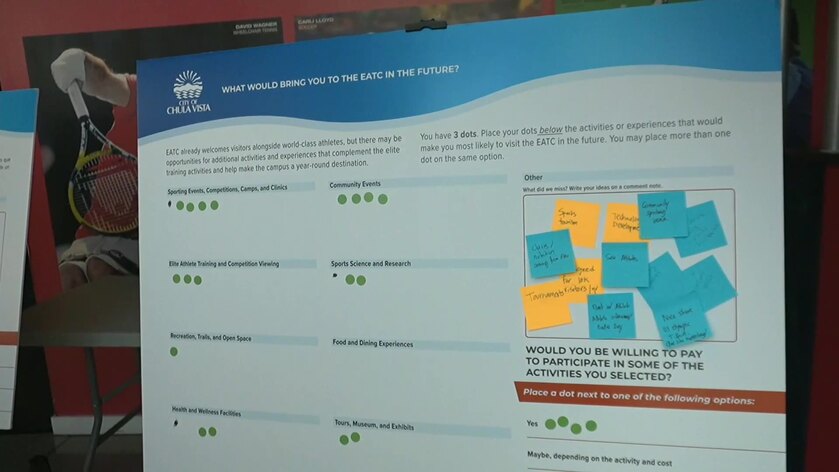
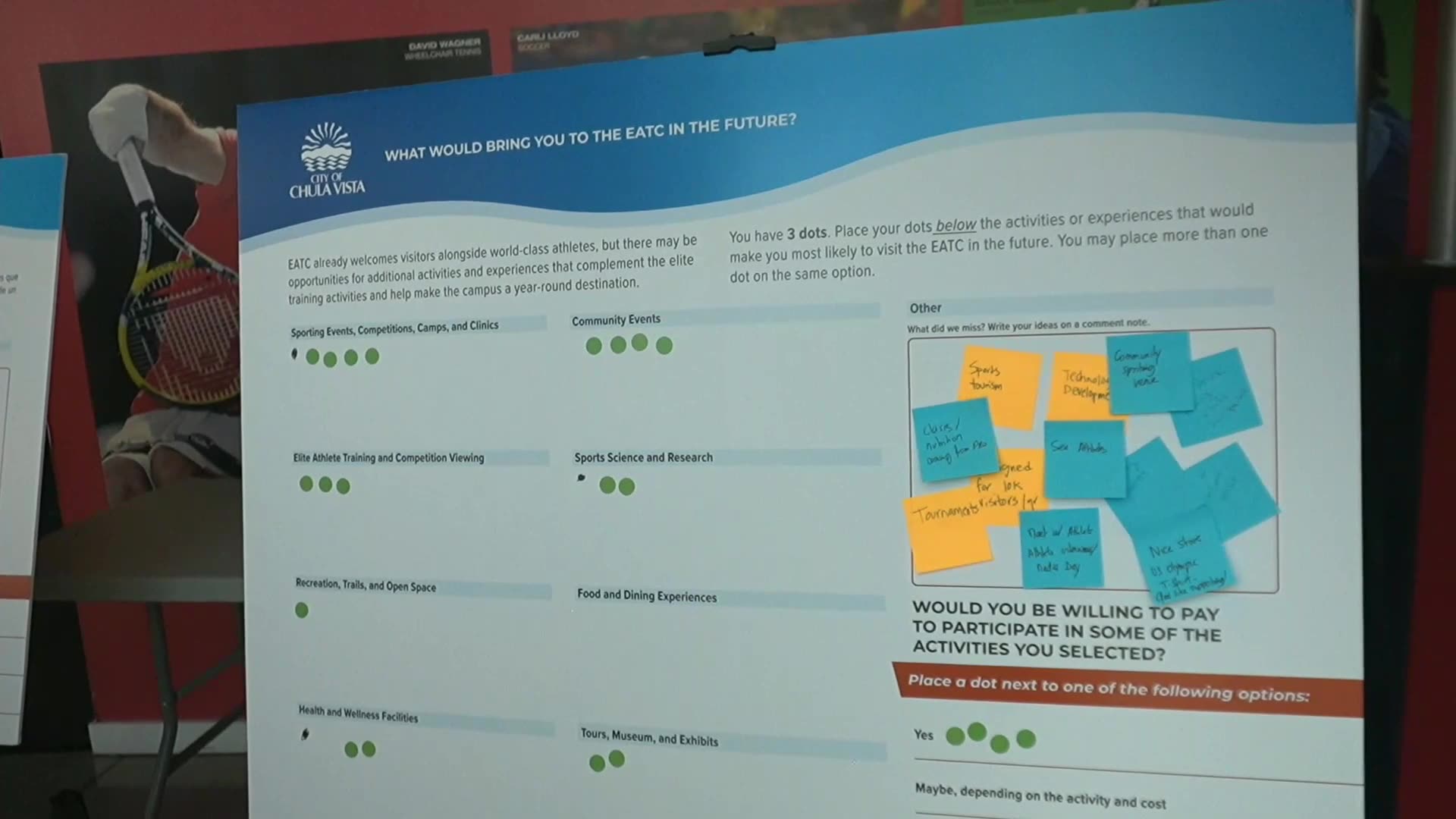
The open house was a community workshop in an early stage of a master plan for the Chula Vista Elite Athlete Training Center. Brian Melekian, who introduced himself as president and chief operating officer for the training center, said residents could give input in two ways: by attending the workshop, which had boards asking how people use the center, what it does well and what it is missing, or through the City's community voices online portal. He said the process will probably take about another year, that this was one of the first of these meetings, and that the consulting firm Dudek will put the input into a report that will go before the City Council.
An urban planner with Dudek who gave her first name as Elizabeth said the firm was contracted by the City. She said the center covers 155 acres and is used primarily for elite athlete training, including Olympians and Paralympians, with fields, gymnasiums, on-site athlete housing and dining, plus public access to trails and annual events such as the Fourth of July fireworks. She said the review covers the whole facility, physical, economic, partnerships, contracting and programming, and will produce a 20- to 30-year plan. She said the goal is to maintain elite athlete training while building on it, and raised the question of how to open up public access while keeping some privacy for athletes who live on site.
About 10 people had come through when the stream began, according to an exchange at the sign-in map. Strong winds later moved the boards indoors.
History and the operator contract
Melekian said the center opened in 1995 and served only the U.S. Olympic Committee until 2017, when the City of Chula Vista took over ownership and engaged Elite Athlete Services to operate it. He said the company renewed a 10-year operating contract in December 2025, and that both sides acknowledged the 30-year-old facility needs work. Rather than proceed project by project, he said, they chose a broader master plan to decide what to fix, add, change or remove, and the City helped start the process when it signed the extension. He said dates for future workshops would be made public by Dudek and the City.
Public access and events
Melekian said many people at the July 4 fireworks, which he called the center's biggest annual event drawing a couple thousand residents, tell him they did not know they were allowed to visit. He said the public can take a self-guided walk down the spine of the campus, book a guided tour, or book an enhanced tour with lunch in the dining hall. He gave the center's website (heard as "train it at Chula Vista dot com"); tour options are listed under Tours. He said former tennis courts have been converted to pickleball courts open to the public.
He said the center held a 5K the previous weekend and has another in November (he first said Nov. 13, then corrected it to Nov. 14). Last year it hosted a drone show that he said drew about 2,000 people over two nights. Looking ahead, he said the center hears requests for concerts and named smaller, boutique concerts and high school or club soccer championships as possibilities, while saying it would not replace the amphitheater or Snapdragon Stadium and is not built to be a weekly tournament venue. As one idea, he described an artificial turf field used by elite athletes during the day and by the community after school.
He said the challenge is to maintain the facility at the standard expected of what he called the biggest Olympic training center in the world, which he said produced 92 medals at the Paris Games, while giving the community the access it wants.
Schools and partnerships
Melekian said the center has a full-time classroom as an "innovation station" through the school district, with students on site every day and a couple hundred children touring on a given day. He said San Diego FC brings training it cannot accommodate at its Singing Hills facility to the center, and that in June the center announced a relationship with Bayern Munich, which set up the center's first residential student athletes who live, attend school and train on site.
He said his background is in professional soccer, and that the 155-acre campus has produced roughly 2,500 medals in its 31 years.
Public comments heard on the stream
Robert Johnson of Chula Vista Live Data, speaking as a resident, asked that public access to the trails and events be kept, suggested more community events such as Taste of Italy to draw visitors to the city's east side, suggested promoting legal drone flying and drone sports photography in suitable nearby areas, and suggested better internet access for livestreaming sports from the site. He encouraged residents to fill out the online survey. The Dudek planner said drones had not been part of the assessment so far and noted that athletes live on site.
A man who identified himself as Jeff Becker, publisher of a Chula Vista magazine, said he has published interviews with Melekian and athletes at the center and pointed viewers to his magazine's website.
LIVESTREAM :
Website : https://www.chulavistalivedata.com
Fact-check notes (public sources)
- CVLD livestream replay (public, streamed Oct. 21, 2026, 4:41 p.m. PT, 31:30):
- Event time and address as listed in the CVLD replay description.
- City master plan page and Oct. 21 open house listing: https://publiccomment.chulavistaca.gov/w31500
- City master plan survey (open through Nov. 13, 2026): https://publiccomment.chulavistaca.gov/p70562
- Dec. 16, 2025 City Council minutes (EAS 10-year operating agreement, Resolution 2025-215): https://pub-chulavista.escribemeetings.com/Meeting.aspx?Agenda=PostMinutes&;Id=ac215348-fe22-4697-ab79-0a624d3d9f2c&lang=English
- Staff report 25-0277 on the EAS agreement: https://pub-chulavista.escribemeetings.com/filestream.ashx?DocumentId=57107
- Staff report 26-0074 on the Dudek contract and the master plan: https://pub-chulavista.escribemeetings.com/filestream.ashx?DocumentId=60049
- CVEATC executive team: https://trainatchulavista.com/our-team/
- City community events (Champions Run 2026): https://www.chulavistaca.gov/departments/parks-and-recreation/special-events
- FC Bayern academy announcement (May 18, 2026): https://www.prnewswire.com/news-releases/fc-bayern-announces-its-first-residential-academy-in-usa-302774930.html
- Source: machine transcript of the CVLD livestream (no official captions). Figures (155 acres, 1995, 2017, December 2025 contract, 92 Paris medals, about 2,500 medals, 5K date) are as spoken by the presenters; pending human verification.