JDATA
Politics • Education • News
Board of Ethics Faces Scrutiny Over Transparency and Delayed Actions
DRAFT1
April 01, 2026

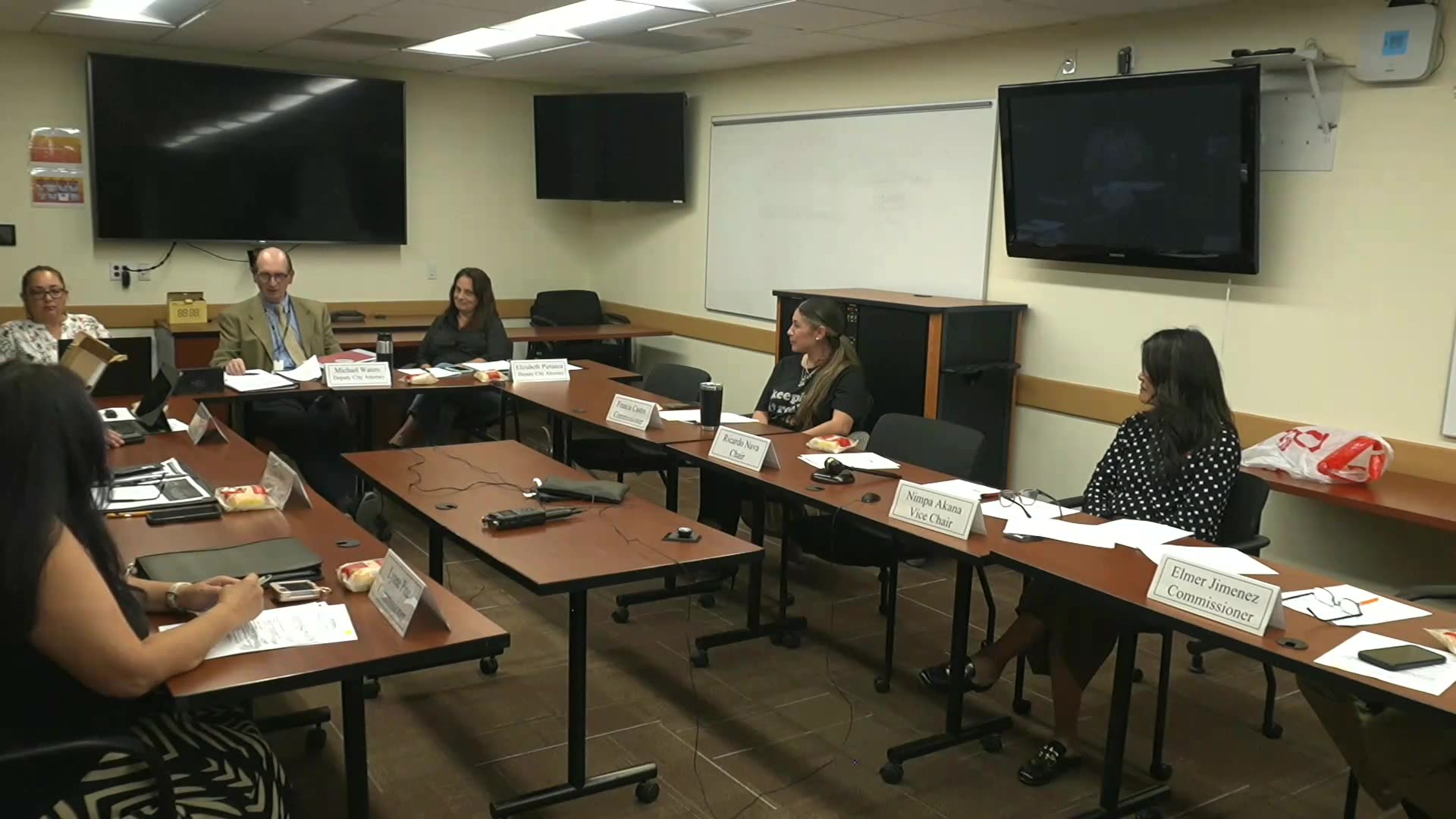
**At its meeting on March 18, 2026, the Board of Ethics addressed a full agenda, but faced public criticism regarding procedural transparency and a lack of documentation for key action items, leading to the postponement of decisions on major ordinances.**

The Wednesday evening session, which began at 5:17 p.m., was marked by pointed public commentary from local resident Robert, who repeatedly highlighted inconsistencies in board procedures and a lack of accessible supporting documents for the public. Key items, including discussions on the draft lobbying ordinance and amendments to the code of ethics, were tabled until the April meeting due to ongoing research and review by the City Attorney's office.

The primary concern raised was the public's inability to engage with agenda items that listed "potential action" without providing any attached reports, red-lined drafts, or background information. "I don't know what you want me to say for any of these items if there's no paperwork on any of it," Robert stated during public comment. "If the point is to make it more difficult for the public here to engage, just keep going." He argued that for the board to fulfill its mission, it must ensure that all relevant materials are made available ahead of time for public review.

In response, Deputy City Attorney Elizabeth Giatonza explained the delay, noting that the research required for the proposed ordinance changes was more extensive than anticipated. "We wanted to keep it on there in the off chance we could have our review done by today, but unfortunately, we just we have not had enough time," she clarified, assuring the board and public that the documents would be available for the April meeting.

The board also received an update from its ad hoc subcommittee on the selection of a Campaign Contribution Enforcement Authority. The subcommittee announced it had interviewed five law firms and selected four to create a panel of legal experts who can be called upon as needed. The process was lauded for its thoroughness, which included accommodating an interview that was delayed due to unforeseen travel disruptions.

In a significant development, it was announced that the board has received a formal complaint and will convene a special meeting on April 8, 2026, at 4:00 p.m. to address it. While details of the complaint were not disclosed, the announcement signals that the board is moving into "new territory," as noted by Chair Sotelo. This upcoming special session, coupled with the public's call for greater transparency, places the Board of Ethics at a pivotal moment, challenging it to balance procedural integrity with its fundamental duty of public accountability.




community logo
Join the JDATA Community
To read more articles like this, sign up and join my community today
0
What else you may like…
Videos
Posts
Articles
November 04, 2023
LOCALs ONLY CONTENT.

WELCOME TO THE CLUB.

00:03:01
June 03, 2022
Diablo immortal
00:00:19
April 01, 2022
Comments open
00:01:08
March 14, 2026
The Financial Beat: Chula Vista’s Q2 Money Update

The March 17 City Council meeting provided a deep dive into the City's financial health, uncovering both revenue challenges and strategic investments. Here is a breakdown of how your tax dollars are being managed and where the money is going as of the Second Quarter of Fiscal Year 2025-26.

1. The General Fund: A $3.9 Million Revenue Shortfall

Total General Fund revenues are projected to be $3.9 million lower than the Amended Budget. While the City is still seeing 6.6% growth in property tax over last year, several key sectors are underperforming against expectations:

Property Tax: Projected to be $3.1 million below budget. This is due to a cooling housing market, a decline in home sales, and the timing of assessments for the new Gaylord Pacific Resort.

Transient Occupancy Tax (TOT): Projected to be $3.4 million lower than budgeted. Shortfalls in Bayfront receipts and a delay in the opening of two other new hotels significantly impacted this category.

Offsetting Gains: Stronger-than-expected Franchise Fees (up $0.6M) and other ...

February 24, 2026

draft OnE IS TO COMPETE WITH CVPD AI..

February 24, 2026
Clean Audits, Community Learning, and Calls for Safety: Southwestern College Board Meeting Highlights

draft 1
Southwestern College’s Governing Board met in Chula Vista on February 23, 2026, delivering a clean financial bill of health while hearing urgent appeals from students on campus safety and immigration concerns. The packed session, accessible via Zoom, showcased the district’s expanding Continuing Education programs and affirmed a year‑round commitment to Black History.
In audited finances, external auditor Rachel Green of Eide Bailly reported three unmodified opinions—financial statements, federal awards, and state compliance—alongside clean financial and performance audits for Proposition Z. “Three unmodified opinions means three clean bills of health,” she said, noting no audit adjustments were required and that 83% of Prop Z expenditures tested were used for authorized projects.
The board spotlighted Continuing Education’s growth through noncredit classes, community education, contract training, and the modernized YES Academy. Programs are designed to “meet ...

15 hours ago
post photo preview
Citizen Activist Halts Virtual Meeting, Citing Public Access Violation
DRAFT1

**CHULA VISTA** – A special meeting of the San Diego Community Power (SDCP) board scheduled for Monday, June 1, 2026, was abruptly canceled after a local citizen, Robert Johnson, highlighted a significant public access issue. The meeting, intended to be held virtually via Microsoft Teams, was called off when Johnson, present at Chula Vista City Hall, pointed out that the publicly noticed location was not accessible for public participation as required by law.

The issue arose from the meeting's public notice, which stated that board members would participate virtually from locations listed on the agenda, including Chula Vista City Hall at 276 Fourth Avenue. Under the Brown Act, which governs public access to meetings of local government bodies, if a location is listed on the agenda for a member's participation, it must be accessible to the public. Johnson arrived at City Hall to attend the 5:00 PM meeting, intending to test this provision.

Upon finding no designated room or access provided for the public, Johnson engaged with City Hall staff, who were initially unaware of the specific requirements for the hybrid meeting hosted by SDCP, a separate entity. Johnson methodically documented his efforts to gain access, contacting the City Clerk's office, the Mayor's office, and leaving a message for Councilmember Michael Inzunza, who was listed as a board member. "I'm at Chula Vista City Hall, which is a listed location, and they're going to close the city, and there's not going to be access to the public to attend," Johnson stated upon joining the virtual meeting from his phone.

His persistence paid off. Once connected to the virtual meeting, Johnson directly addressed the board, explaining the situation from the ground at City Hall. The board members, including the chair, acknowledged the problem. "The notice location for the Chula Vista location is not open. That... needs to be open for this meeting to continue. Unfortunately, we'll need to cancel," the chair announced to the attendees. The meeting was officially canceled shortly after it began.

This incident highlights the intricate challenges of ensuring transparency and public access in an era of hybrid and remote meetings. While technology offers flexibility, it also creates new responsibilities for public agencies to uphold the spirit and letter of open meeting laws, ensuring that no member of the public is inadvertently locked out of the democratic process.


Read full Article
May 17, 2026
Public Controversy: Chula Vista Artist in Residence and Inappropriate Social Media
DRAFT1


**CHULA VISTA, CA** – An artist commissioned by the City of Chula Vista for its Casa Casillas Art in Residence program has been linked to a secondary, undisclosed Instagram account containing inappropriate and sexually explicit imagery. The discovery has raised questions about the city's vetting process for publicly funded artists.


The artist, was promoted by the city through his official art account, @g********. However, a separate audit uncovered another account, @g*****8, which also featured the artist’s work and personal posts. While the city did not promote this second account, it appeared to be managed by the artist himself and was linked to his activities at the Casa Casillas residency.

Auditors found concerning images on the @g*****8 account, including what was described as a photo of the artist in a “compromising pose” and another explicit image posted on his last day of the residency. “It was a painting of a man and his ball sack hanging, which then prompted us to release this information because we considered this the last day he was being advertised by the city,” stated a source familiar with the audit. The explicit post was reportedly shared alongside an announcement of his final day working at the city-funded location.


The group that uncovered the account believes the city was unaware of its existence and has since shared the captured images with city officials. Following these events, the @g*****8 account was removed and is no longer publicly accessible. The source noted that the artist's professional website also features erotic artwork, with a style consistent with the images found on the now-deleted Instagram page.


"We thought it was appropriate for the public to know what the artists are doing when they're funded by the city," the source commented, emphasizing their role as a public watchdog.


The situation leaves Chula Vista residents and art patrons to ponder the balance between artistic freedom and public accountability. As the city invests in cultural programs to enrich the community, this incident highlights the challenges of navigating the digital age, where the line between an artist’s private life and public persona can become blurred, prompting a necessary review of oversight for future publicly funded initiatives.

Article made with AI from AUDIO and Wrote with Jdata17


Read full Article
May 12, 2026
Public Meeting: Chula Vista ArtFest Planning, Public Art Policy, and Governance Procedures
DRAFT1

Murals, Dance Floors, and a Debate on Process: Chula Vista Arts Agenda Moves Forward

On May 6, 2026, at City Hall, Chula Vista’s arts bodies and residents packed a long evening with proposals to refresh public art, expand the September 26 ArtFest, and tighten meeting conduct—revealing both momentum and friction in how the city advances culture.

The Chula Vista’s Cultrual Arts Commission met at 6:08 p.m. at City libarry to shape ArtFest 2026. Organizers aim to broaden access, safety, and representation. Commissioners cited possible injuries from dancing on grass and sought cultural diversity onstage; residents asked for transparent curation of murals and easier public comment; and commission leaders pressed for unity in public messaging after a proclamation for Arts, Culture, and Creativity Month exposed internal strains.

 ArtFest planners proposed a 40-foot lawn dance floor, 15-minute rotating sets mixing bands, DJs, folklórico, and school ensembles, and a culinary demo tent with local chefs. “We need to see these documents… to give the commissioners the best scope of the work,” public speaker Robert said, urging budget clarity. Another speaker, Alan Corr, advocated showcasing student and local art in civic spaces to “plant that seed” for future pride.

Commissioners postponed approval of prior minutes to verify a motion on performing arts venues, underscoring procedural care. Separately, a resident arts advocate asked the city to survey public feedback and economic impact of courthouse-area murals and to prioritize local artists.

A dispute flared over remarks tied to a proclamation: colleagues warned that calls for a performing arts center could imply commission endorsement without a vote. “We are a commission, and we need to be represented as a commission, not individually,” one member said, invoking Brown Act limits. The Brown Act requires timely posting of agendas and ensures the public’s access to meetings. A day later the Auditor described prior instances where meeting doors were locked after closing time while proceedings continued, (YOU CAN HEAR IN THE LIVE STREAM THEM SAY OF THIS MEETING  "We are out of time") temporarily barring public access. “Members of the public were not given access to a public meeting that was still going on,” he said, adding that some departments have since begun propping doors open after complaints. Comment from auditor were made after reviewing the footage.


What’s next — The plans now blend safety upgrades, educational showcases, and wider community participation, while a small-scale West Side library event and rotating civic exhibits are under review. As Chula Vista weighs foot traffic, local commissions, and the stories its murals inspire, the larger question remains: can passion and process align to turn civic spaces into stages where the whole city belongs?


Article made with AI from AUDIO and Wrote with Jdata17


LIVE STREAM : https://rumble.com/v79i03w-live-stream-may-2026-jdata17.html?e9s=src_v1_upp_a


placeholder

Read full Article
See More
Available on mobile and TV devices
google store google store app store app store
google store google store app tv store app tv store amazon store amazon store roku store roku store
Powered by Locals