

By Robert Johnson | jdata17
Oct. 2, 2026 · National City, Calif.
Chula Vista Mayor John McCann and challenger Francisco Tamayo met face to face Friday night at Politifest South County, offering sharply different pictures of the same city. McCann described a fiscally disciplined "economic engine." Tamayo described a city where working families can't afford a home and visitor dollars drive right past it.
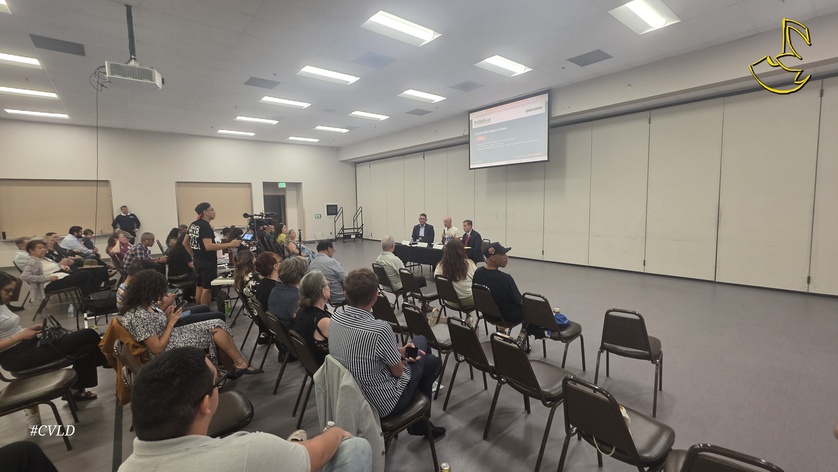
The forum, hosted by Voice of San Diego at the Martin Luther King Jr. Community Center in National City, opened with the National City mayoral race and closed with the Chula Vista contest. VOSD South County reporter Jim Hinch moderated. Each candidate had about five minutes per question, followed by moderated back-and-forth and audience questions submitted through an app. McCann is the incumbent Republican. Tamayo, a Democrat, is a trustee on the Chula Vista Elementary School District board.
Budget and the Bayfront
Asked how they would keep the city on solid footing in an uncertain economy, McCann, who called himself "a finance guy," said the city built a 15% reserve over years and refinanced its unfunded pension liabilities with pension obligation bonds at low interest rates, which he said "saves our budget about 14 million dollars a year." This year's budget, he said, came with "no cuts in services," no layoffs, no new taxes and "definitely no parking fee increases."
"We have laid a foundation of strong financial stability," McCann said. He called the Gaylord Pacific Resort, the anchor of the Bayfront Master Plan, "Chula Vista's overnight success story for 22 years." He described it as a $1.3 billion project that produced more than 3,000 construction jobs and 1,500 to 2,000 permanent jobs. He pledged to put "a portion of that revenue" into sidewalks and roads in older neighborhoods, and highlighted a planned 100-acre High Tech Innovation Center meant to keep some of the roughly 80,000 to 90,000 residents who he said commute out of the city each day. He also cited a Southwestern College study that identified nursing as the region's top in-demand job, which led to an agreement with San Diego State to offer nursing classes at the new Millenia Library.
Tamayo countered that the city "had to take money out of reserves" to balance this year's budget, calling it "a signal that shows that the economy is not doing great." He said the Bayfront was missing a business and entertainment district: "Those hotel rooms cost five hundred dollars a night." He claimed the project would take "12 years to even break even" and warned of deficit spending and layoffs down the road unless the city adds an entertainment district and revives Third Avenue, which he said "is dying." Visitors to the Gaylord, he said, go to downtown San Diego to eat and be entertained. "So we're losing money right there," he said.
McCann called the layoff prediction "ridiculous." He said the Bayfront has three times as many hiking and walking trails as before, a new Sweetwater Park he called the largest park in the Port District, and weekly key passes for residents to the resort's water park. He said the Gaylord Pacific is "number three out of that six thousand" Marriott properties worldwide in revenue generation. He then went after Tamayo's school board record, claiming the district faced a $40 million deficit that one-time state money reduced to $16 million, and that Tamayo voted to lay off teachers and classified staff and to reduce school resource officers.
Tamayo answered that the district's cuts reflect falling enrollment. "That's because people are leaving, John," he said. McCann said the city is growing and that school officers are funded under a cost-sharing agreement, with the city paying half.
Housing Affordability
Asked how they would make housing affordable for lower- and middle-income residents, McCann pointed to what he called the "missing middle" and said he pushed developers toward ownership instead of apartments. That produced Sunbow II, a Lennar project near Interstate 805 and Olympic Parkway with 718 entry-level homes on land once zoned industrial, and Citrus Bay, a CalWest project with 244 townhomes on the former Sears site, which he called "the biggest new housing project in Chula Vista in over three decades."
Tamayo questioned what counts as affordable. "A $600,000, a $700,000 home for an entry level is not affordable," he said, adding that buyers would need about $150,000 in income at 7% interest rates. He promoted his Chula Vista Heroes Plan, which would use city-owned land, work with developers, add state and county grants, and use preapproved floor plans to sell homes below $500,000. It would also seek a special long-term interest rate from banks instead of an introductory rate, and it targets teachers, police officers, firefighters, nurses, and workers at places like Walmart and McDonald's. "We're becoming a renter community," Tamayo warned. "We need 10,000 homes in Chula Vista now, not tomorrow."
McCann replied that "the issue right now is supply and demand." He said he has helped approve more than 30,000 new homes and that local prices remain more than $100,000 below the county average. He proposed using artificial intelligence to catch errors in permit applications before they are submitted, and cited a Point Loma Nazarene University study that found "forty percent" of the cost of new housing "was government." He said a school district subcommittee Tamayo sits on had produced "zero" teacher homes.
After Hinch asked the crowd to hold its applause and boos, Tamayo pressed again: "I'm yet to hear how much is affordable." He dismissed the AI proposal as more of the same, telling McCann, "ChatGPT didn't start yesterday, John," and said average rent for a two- or three-bedroom home in Chula Vista is "north of three thousand dollars."
Homelessness
Hinch noted that police and fire officials told him homelessness-related incidents have become one of their top sources of calls. McCann described a Homeless Outreach Team that pairs police with social workers and nonprofits. He also described a bridge shelter of 65 pallet homes with wraparound services and a high-barrier entry rule: "you've got to be clean." He added that the city has one of the county's strictest encampment bans, and claimed homelessness fell 25% this year.
Moderator Jim Hinch responded from the stage: "And as a journalist, I can confirm that that figure is inaccurate." He then turned to Tamayo. (The Fact Check below looks at what the public data shows.)
Tamayo called the shelter "a good project" but said it is "half baked" because it lacks a path to jobs. He proposed job-training partnerships with Southwestern College and leveraging county funding for long-term support. He said unsheltered people have spread into eastern neighborhoods, including Otay Ranch, where he lives. McCann responded that "a hundred people" have graduated from the Otay bridge shelter into permanent housing, and that many have jobs.
Affordability, the Latino Community and Public Safety
In audience questions, both candidates named affordability as the city's biggest challenge. McCann said he opposes mileage, gas, new sales and new real estate taxes. Tamayo said residents spend "forty, almost fifty percent" of their income on housing and called for incentives to bring high-paying jobs, saying the city should "not just be a sleeper city."
Asked how they would support the Latino community during increased immigration enforcement, McCann cited four years of the city's El Grito celebration, which he said draws thousands, a 21-flag raising for Hispanic Heritage Month, and FBI data he said ranks Chula Vista among the 10 safest U.S. cities with more than 200,000 residents. When McCann turned to a newly signed state bill he tied to fighting human trafficking, Tamayo asked, "Are you saying that Latino community has human trafficking?"
Tamayo, noting that about 67% of the city is Latino, said that even as a U.S. citizen, "I still carry my passport because I feel fearful because of the color of my skin." He proposed using the city's existing app to alert residents to ICE activity in their neighborhoods. "We can't stop it. We can't prevent it," he said, but the city's job is to make sure residents "have the information they need."
What's Next
The choice before voters is a clear one. McCann is running on his record on reserves, the Bayfront and housing approvals. Tamayo argues those gains haven't reached families struggling with rent and home prices.
Fact Check
We checked the candidates' main factual claims against public records and news reports. Verdicts: Accurate, Mostly accurate, Needs context, Unsupported or Could not verify. The numbers at the end of each item refer to the Sources list below.
Featured: McCann's claim that homelessness fell 25%
The claim. McCann said the number of homeless people in Chula Vista "went down by twenty five percent" this year, "one of the highest decreases in homelessness in the entire county." Sources: 3.
What happened on stage. Right after McCann's answer, moderator Jim Hinch said, "And as a journalist, I can confirm that that figure is inaccurate." He didn't say which number he meant before turning to Tamayo. Sources: 3.
What the count shows. The Regional Task Force on Homelessness's January 2026 Point-in-Time Count found 355 people living unsheltered in Chula Vista. That's down from 470 in 2025, a drop of 24.5%, or about 25%. Sources: 4, 5, 6.
What it leaves out. The same count found 340 people in shelters, up from 144 in 2025. So the total number of homeless people counted in Chula Vista went up, from 614 to 695, an increase of about 13%. Over the same year, the count's tally of emergency shelter beds in the city went from 105 to 315. Sources: 4, 6.
How it compares. Across the region, unsheltered homelessness fell 11% and total homelessness fell 1%. RTFH listed Chula Vista's 24.5% unsheltered drop among the larger local declines, along with El Cajon (39.5%), La Mesa (25%) and Santee (64.1%). Sources: 5.
Earlier reporting. In May, Voice of San Diego (in a story by Hinch) described the change as a drop of "nearly 25 percent" in the number of unsheltered people. Sources: 7.
Verdict: Needs context. The 25% figure matches the drop in unsheltered homelessness. Homelessness overall rose, because many more people were counted in shelters. McCann didn't make that distinction on stage.
Other claims we checked
65-home bridge shelter (McCann): Accurate. The city opened Chula Vista Village at Otay in May 2023 with 65 pallet homes and services on site. Sources: 8.
"A hundred people" moved from the shelter into permanent housing (McCann): Could not verify. A city staff report says the shelter has served 210 people since May 2023. It counted 39 exits "to permanent or temporary housing" from July 2025 through June 2026. In April, coverage of McCann's State of the City said more than 100 people had received support this year and many had moved into permanent housing. We found no public figure showing 100 permanent placements. Sources: 9, 10.
15% reserve (McCann): Accurate. City policy sets a minimum General Fund operating reserve of 15%, plus separate contingency and catastrophic reserves. VOSD reported in April that the city balanced its budget with "fully funded reserves." Sources: 11, 14.
About $14 million a year in pension savings (McCann): Accurate, as a projection. When the city issued $350 million in pension obligation bonds at 2.54% in 2021, it projected savings of "over $14 million annually on average for the next 15 years." How much it actually saves depends on CalPERS investment returns. Sources: 12.
The city "had to take money out of reserves" to balance this year's budget (Tamayo): Unsupported. VOSD reported that the 2025-26 budget passed without "raiding city reserves" and that the 2026-27 budget had "no raids on the city's reserves." Context: the city's own long-term plan projected a General Fund gap of $5.3 million for fiscal 2027, with smaller gaps through 2031, to be closed during budgeting. Sources: 7, 11, 13.
Gaylord Pacific is a $1.3 billion project (McCann): Accurate. Marriott's 1,600-room resort and convention center opened in May 2025 as a $1.3 billion project. Sources: 15, 16.
Gaylord is Marriott's No. 3 property by revenue (McCann): Needs context. Port officials, including Chula Vista's port commissioner, have described it as Marriott's third-highest-grossing property worldwide. But the hotel doesn't share its financial results with the city, and Marriott didn't answer VOSD's questions. VOSD also reported that taxes from the resort area this year (about $25 million) are expected to fall short of about $29 million in bond payments, leaving a gap of about $3 million to be paid from reserves set aside for that purpose. Sources: 16, 17.
Rooms cost $500 a night (Tamayo): Mostly accurate. VOSD reported that rooms start at about $400 a night and can cost more than $1,000. Sources: 16.
The resort will take 12 years to break even (Tamayo): Needs context. The Port projects the project will bring in more than its bond payments and reimbursements in years 15 to 19 of operation. A 2022 analysis had predicted surplus revenue in year two. We found no official 12-year figure. Sources: 16.
Gaylord visitors aren't spending on Third Avenue (Tamayo): Mostly accurate. Councilmember Cesar Fernandez told VOSD the overflow business hasn't reached Third Avenue: "I don't think conventioneers get that far." Sources: 16.
Sweetwater Park is the Port's largest park (McCann): Accurate. The 39-acre park opened on the Bayfront in April 2025 as the Port's largest. Sources: 18.
718 homes at Sunbow II (McCann): Accurate. The city's development agreement for Sunbow II Phase 3 allows 718 multifamily homes: 534 medium-high density and 184 high density. Sources: 19.
244 for-sale townhomes at Citrus Bay (McCann): Accurate. VOSD confirmed 244 for-sale townhomes on the former Sears site, with three-bedroom homes selling for about $687,000. That's within the $600,000 to $700,000 range Tamayo said is out of reach for many families. Sources: 7.
More than 30,000 homes approved (McCann): Could not verify. We found no public total. McCann separately told VOSD the city produced nearly 4,000 housing units last year. Sources: 20.
Prices are more than $100,000 below the county average (McCann): Accurate. In August 2026, Chula Vista's median sale price was $844,500, compared with $950,000 countywide. That's about $105,500 lower, based on a real estate site's compilation of closed sales. Sources: 21.
Point Loma Nazarene study: 40% of the cost of new housing is government (McCann): Mostly accurate. A 2015 study by PLNU's Fermanian Business & Economic Institute found that regulations and delays add 40% to the cost of new housing in the San Diego region. The study is more than 10 years old. Sources: 22.
Top 10 safest U.S. cities over 200,000, per the FBI (McCann): Needs context. The top-10 ranking comes from a 2013 list by a private website that used 2012 FBI data. VOSD reported in May that Chula Vista falls "about in the middle of the pack" in FBI data among California cities its size, though major violent crimes have gone down since 2022. Sources: 7, 23.
Tamayo's school district had a $40 million deficit, cut to $16 million with one-time state money (McCann): Needs context. VOSD reported the Chula Vista Elementary School District's deficit at $33.6 million in February and about $30 million in April. More state money and cuts later brought the current-year deficit down to $16 million, and layoff notices to 41 teachers were taken back. Tamayo has said the deficit came from intentionally spending reserves on students. Sources: 20, 24, 25.
SDSU nursing classes at the new library (McCann): Accurate. In April, the City Council approved a 10-year lease for SDSU at the Millenia Library. Its hybrid nursing program is expected to start in spring 2027. Sources: 26.
Tamayo's Heroes Plan (Tamayo): Needs context. Tamayo's campaign site lists homeownership as a priority. On the pages we reviewed, though, it doesn't spell out a "Heroes Plan," a home price under $500,000 or special interest rates. He has previously proposed pre-approved building plans and a higher income limit for the city's first-time buyer program. Sources: 20, 28.
Sources
- Voice of San Diego: Politifest 2026 (event page): https://voiceofsandiego.org/event/politifest-2026/
- Voice of San Diego: "Sharp Contrasts in South County Mayoral Races" (Sept. 23, 2026): https://voiceofsandiego.org/2026/09/23/sharp-contrasts-in-south-county-mayoral-races/
- jdata17 recording and Plaud transcript of the Chula Vista forum (Oct. 2, 2026; video to be released Monday)
- Regional Task Force on Homelessness: 2026 Point-in-Time Count, City of Chula Vista (PDF): https://www.rtfhsd.org/wp-content/uploads/2026/05/2026-PIT-Chula-Vista_Final.pdf
- Regional Task Force on Homelessness: "Unsheltered Homelessness Drops 11% Across San Diego Region" (May 1, 2026): https://www.rtfhsd.org/unsheltered-homelessness-drops-11-across-san-diego-region-as-investments-show-results/
- Regional Task Force on Homelessness: 2025 Point-in-Time Count, City of Chula Vista (PDF): https://www.rtfhsd.org/wp-content/uploads/2025/05/2025-Chula-Vista.pdf
- Voice of San Diego: "Chula Vista's Mayor Is Suddenly Fighting on All Fronts to Win Re-Election" (May 14, 2026): https://voiceofsandiego.org/2026/05/14/chula-vistas-mayor-is-suddenly-fighting-on-all-fronts-to-win-re-election/
- City of Chula Vista: "Chula Vista Village at Otay Opens May 15" (May 12, 2023): https://www.chulavistaca.gov/Home/Components/News/News/3627/17
- City of Chula Vista staff report: Housing services agreement with Imperial Beach (Aug. 18, 2026): https://pub-chulavista.escribemeetings.com/filestream.ashx?DocumentId=64834
- RTFH (news repost): "Chula Vista mayor touts homeless solution in State of the City" (Apr. 28, 2026): https://www.rtfhsd.org/chula-vista-mayor-touts-homeless-solution-in-state-of-the-city/
- City of Chula Vista: General Fund Long-Term Financial Plan, FY2027-2036: https://pub-chulavista.escribemeetings.com/filestream.ashx?DocumentId=56536
- City of Chula Vista: Pension Obligation Bonds: https://www.chulavistaca.gov/departments/finance/pension-obligation-bonds
- Voice of San Diego: "South County Report: Budget Blues" (June 24, 2025): https://voiceofsandiego.org/2025/06/24/south-county-report-budget-blues/
- Voice of San Diego: "South County Report: State of the City and Then Some" (Apr. 30, 2026): https://voiceofsandiego.org/2026/04/30/south-county-report-state-of-the-city-and-then-some/
- Hotel Dive: "Marriott opens $1.3B resort, convention center in California" (May 2025): https://www.hoteldive.com/news/gaylord-convention-hotel-opens-california/748327/
- Voice of San Diego: "Chula Vista's Gaylord Hotel May Cost More Than Expected" (Sept. 2, 2026): https://voiceofsandiego.org/2026/09/02/chula-vistas-gaylord-hotel-may-cost-more-than-expected/
- Chula Vista Living: "Gaylord Pacific Resort Celebrates One Year" (May 2026): https://chulavistaliving.com/gaylord-pacific-resort-celebrates-one-year/
- Port of San Diego: "Sweetwater Park is Now Open on the Chula Vista Bayfront" (Apr. 2025): https://www.portofsandiego.org/press-releases/general-press-releases/sweetwater-park-now-open-chula-vista-bayfront
- City of Chula Vista: Sunbow II Phase 3 development agreement: https://pub-chulavista.escribemeetings.com/filestream.ashx?DocumentId=17325
- Voice of San Diego: "Chula Vista Mayoral Challenger Leads with Immigration, Affordability" (Apr. 8, 2026): https://voiceofsandiego.org/2026/04/08/chula-vista-mayoral-challenger-leads-with-immigration-affordability/
- Hello San Diego: "San Diego Home Prices by City" (August 2026 data): https://www.hellosandiego.com/articles/san-diego-home-prices-by-city
- Times of San Diego: "Regulations, Delays Add 40% to Housing Costs, Study Finds" (Apr. 29, 2015): https://timesofsandiego.com/business/2015/04/29/regulations-delays-add-40-to-housing-costs-study-finds/
- KPBS: "Chula Vista Ranked Tenth Safest City In United States" (Nov. 25, 2013): https://www.kpbs.org/news/2013/11/25/chula-vista-ranked-tenth-safest-city-united-states
- Voice of San Diego: "South County Schools Confront Declining Enrollment, Budgets" (Feb. 18, 2026): https://voiceofsandiego.org/2026/02/18/south-county-schools-confront-declining-enrollment-budgets/
- Voice of San Diego: "South County Report: Encouraging Budget News for Chula Vista Schools" (June 18, 2026): https://voiceofsandiego.org/2026/06/18/south-county-report-encouraging-budget-news-for-chula-vista-schools/
- SDSU News: "10-year lease approved, new SDSU location in Chula Vista will be home to hybrid nursing program" (Apr. 2026): https://www.sdsu.edu/news/2026/04/ten-year-lease-approved-new-sdsu-location-in-chula-vista-will-be-home-to-hybrid-nursing-program
- KPBS Events: "Chula Vista's El Grito Celebration" (Sept. 13, 2026): https://www.kpbs.org/events/2026/09/13/chula-vistas-el-grito-celebration
- Francisco Tamayo for Mayor (campaign website): http://franciscotamayo.com/
Watch the full forum: Out of respect for Voice of San Diego, which asked that recordings be held until after it releases its own, the full recorded livestream of this forum will be released on Monday, Oct. 5, 2026 (time TBD). Please watch and support VOSD's version first. Then follow Chula Vista Live Data and jdata17 for our full recording.
LIVESTREAM : [RUMBLE LINK — to be added when the video is released Monday, Oct. 5, 2026]
Hosted by Voice of San Diego (Politifest South County). Independent coverage by Robert Johnson / jdata17, not affiliated with VOSD or the candidates. Quotes are from our recording of the event. Candidate figures are their own claims. The Fact Check above shows what we could and couldn't verify from public sources.
AI WROTE FROM AUDIO WITH JDATA17